Showing posts with label NRA. Show all posts

Wednesday, February 17, 2010

A VIRTUAL VERSION OF ALPHABET SOUP !

FIU STUDENT-CURATED EXHIBIT NOW ONLINE

Thanks to the efforts of Digital Library Specialist David Almeida, a Florida International University student show exhibited in the Green Library on the Modesto Maidique campus in the winter months of 2009/2010 can now be viewed online. Seven undergraduate students studying the Great Depression and New Deal Era researched and selected materials from the Wolfsonian-FIU library and from the Mitchell Wolfson Study Collection in downtown Miami. They displayed those items in an exhibition about the New Deal programs of the Roosevelt Administration. Now that show lives on in a virtual display format which can be viewed by anyone using the internet anywhere around the globe.

The display is arranged according to the themes chosen, researched, and curated by the students. Mariana Clavijo covered President Franklin D. Roosevelt’s earliest New Deal programs: the NRA (National Recovery Administration) and AAA (Agricultural Adjustment Administration). Maria Aliano and Miriam Kashem gathered artifacts from our own rare books library as well as items in Mr. Wolfson’s private collection to examine how the New Deal aimed at solving the issues of problem youth during the Great Depression. Ms. Aliano honed in on the CCC (Civilian Conservation Corps) while Ms. Kashem also explored government-produced pamphlets from the WPA (Work Projects Administration) and NYA (National Youth Administration) aimed at showing how the government was taking care of its younger citizens. Jessica Tejeiro chose items related to the FAP (Federal Arts Project), focusing on federally-funded galleries and community art centers while Kevin Pineiro looked at Federal One projects including: the FTP (Federal Theatre Project), FMP (Federal Music Project), and the FWP (Federal Writers’ Project). Michelle Zavala and Christie Vina teamed up to explore the FWP (Federal Writers’ Project), looking at the American Guide Series of books published to promote travel and tourism to all 48 states and territories of the United States.

Thursday, November 26, 2009

ALPHABET SOUP STUDENT EXHIBIT INSTALLED IN FIU'S GREEN LIBRARY

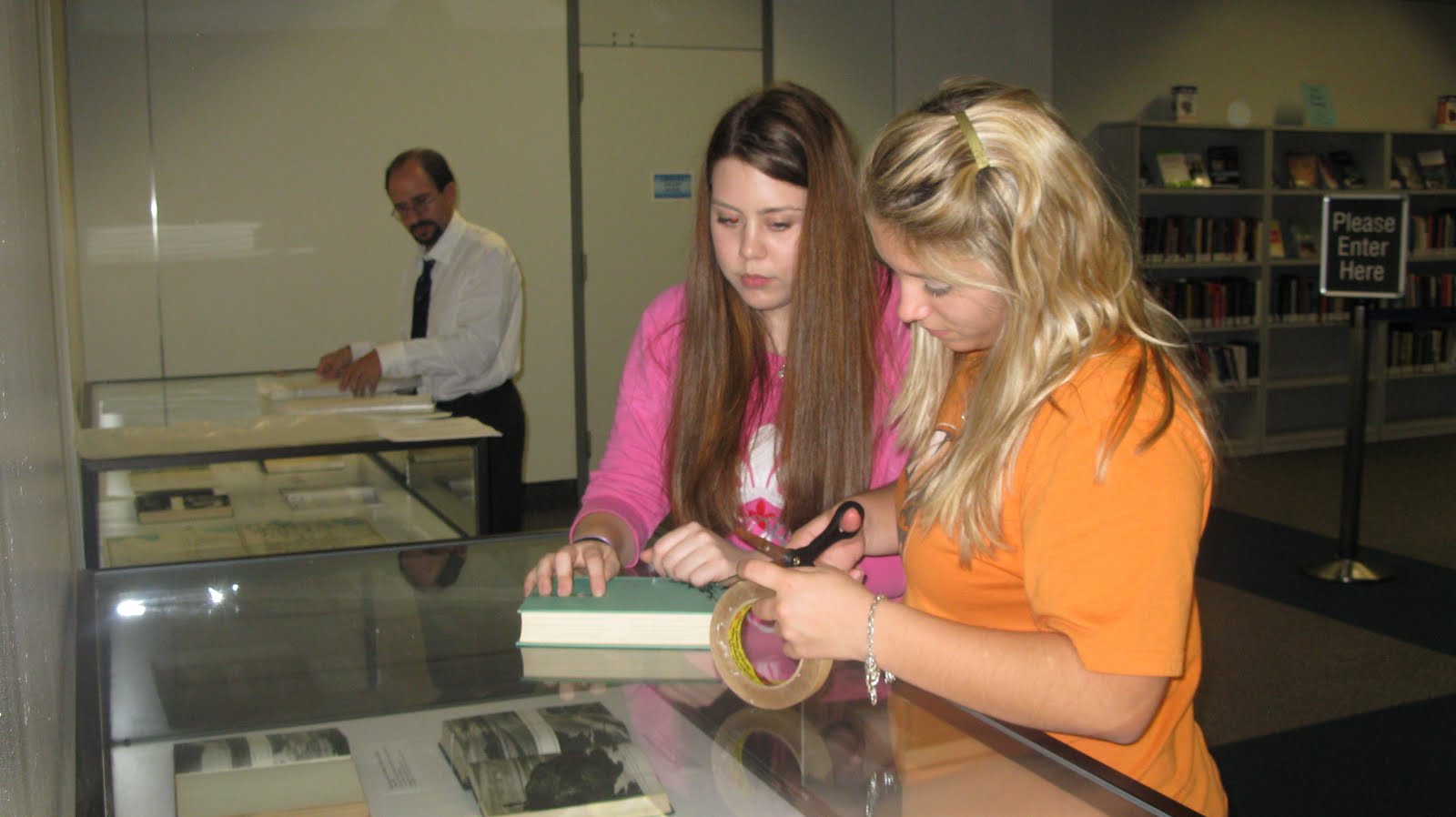
After months of scheduling research visits, picking topics, selecting items, and writing interpretive and descriptive labels, seven Florida International University students studying the Great Depression and New Deal Era installed their exhibit in the Green Library on the Modesto Maidique campus. Unwrapping the carefully-selected materials and installing them and their labels in the cases on the second floor of the library took several hours. The last items were placed in the cases just as their fellow students arrived for the guided tours and a question and answer session.

One of the students, Mariana Clavijo, selected materials from two of President Franklin Delano Roosevelt’s earliest New Deal programs: the NRA and AAA. (It goes without saying that Ms. Clavijo was not interested in either the National Rifle Association or the American Automobile Association). Rather, she used her display to investigate how the National Recovery Administration and the Agricultural Adjustment Administration promoted their plans, and to determine if the reforms actually succeeded in providing real relief to industrial and farm workers hit hard by the Great Depression.


Several of the student curators decided to focus on the Federal Arts Project (FAP, or Federal One). Jessica Tejeiro, for example, chose to display exhibition catalogs and programs for works of art exhibited in federally-funded community art centers and galleries. She also tapped into an archive of official documents and correspondence of Robert Delson, head of the Florida Arts Project in Jacksonville, and illustrator of the Florida Guide.


Speaking of the American Guide Series, Michelle Zavala and Christie Vina worked as a team to hone in on the Federal Writers’ Project, or FWP. Together they filled two cases with some of the books written to encourage domestic tourism by publishing histories and travel guides to the 48 existing states of the Union.

Kevin Pineiro also selected items from the Wolfsonian-FIU library collection for the Federal Arts Project, choosing items that more generally documented New Deal Art, the Federal Theatre Project, the Federal Music Project, and the Federal Writers’ Project.

Two more student curators, Maria Aliano and Miriam Kashem, decided to focus in on those New Deal programs aimed at the young. Ms. Aliano looked at the Civilian Conservation Corp (CCC) choosing items from the Wolfsonian library and borrowing a few rare pamphlets, photographs, annuals, and even a woodblock and a print made by an aspiring CCC artist, Friedolin Edward Kessler (American, 1919–1995). Although Ms. Kashem also picked objects about Roosevelt’s so-called “Tree Army,” she also selected items from WPA (Work Projects Administration) and NYA (National Youth Administration) programs. The WPA funded projects aimed at nursing malnourished children back to health while the NYA provided unemployed youths with educational opportunities and vocational training to turn potential delinquents into upstanding and productive citizens.

A Powerpoint presentation will also be running on the large flat screen monitor in the exhibit area featuring the displays put together by FIU students who opted to do this curatorial project Fall semester 2008. Although this year’s installation came off without a hitch, there was some unexpected excitement during the student-guided tours that followed. Just as Ms. Kashem was pointing out a board game and talking about the forest fire prevention and suppression activities of the CCC, the Green Library’s fire alarms went off! Fortunately, after a fifteen-minute “recess,” the class reassembled and the tour resumed.


We hope to be able to organize a public reception where the the student curators will again have the opportunity to give guided tours and speak about their curatorial experience with Wolfsonian museum founder, Mitchell Wolfson, Jr. in attendance. This event is likely to take place sometime in the late afternoon or early evening, Thursday December 10th. Details to follow!

Saturday, October 3, 2009

ROOSEVELT'S "BLUE EAGLE" CAMPAIGN AND ITS CRITICS ON THE LEFT

This fall semester I am teaching a history course at Florida International University in the evenings entitled, America & Movies: the Great Depression and New Deal Era in Film and History. Forty-five students are enrolled in the class which has been designed to get them to view Hollywood films with a more critical eye and to use other visual and non-literary primary source materials in their research projects. Half a dozen students have opted to work on a special curatorial project using the Wolfsonian's outstanding collection of New Deal era artifacts. The exibits they design will be made available via a link on this blog sometime in late November. Here is a teaser of some of the objects in our collection and the ideas and messages the students have taken from them.


LIBRARY OBJECT(S) OF THE WEEK


Within the first hundred days of taking the oath of office, President Franklin Delano Roosevelt attempt to "jump-start" the moribund American economy back to life through the passage of the first of his "New Deal" programs: the National Industrial Recovery Act (1933) and the National Recovery Administration, (or NRA). The Roosevelt administration consciously promoted this program with patriotic symbols and colors. Charles T. Coiner designed the NRA's emblem, a "blue eagle." This "thunderbird" carried in its talons a cogwheel as the symbol of industry and lightning bolts representing the electrical power that would be generated through other New Deal programs like the REA (Rural Electrification Administration), and the TVA (Tennessee Valley Authority) tasked with building large hydroelectric dams. Although membership and compliance with NRA regulations was voluntary, businesses who refused to display the eagle were often subject to boycotts and in 1935 the conservative judges on the Supreme Court ruled the NRA unconstitutional.


But even before the NRA was challenged and defeated on constitutional grounds, the Left also criticized the program as a "businessman's dole" and a woefully inadequate and inappropriate response to the Great Depression. The Socialist Labor Party chose to attack the NRA in a pamphlet that lampooned its symbol by placing an elitist top hat on its head, and by having workers and industry helplessly suspended in its talons. The text also spoofs the NRA’s lightening bolt imagery, warning that "though an electric current may induce spasms resembling life even in a corpse–so it is utterly impossible to restore life to the corpse of capitalism.” The Communist Party of the United States was equally dismissive of the NRA's efforts on behalf of the working class, and on the cover of the October 1933 issue of the Labor Defender, they superimposed a swastika over, and filled in the hollow outline of the "thunderbird" emblem with sepia-toned photomontages of striking workers being beaten by police and soldiers.

For more information on the Wolfsonian Library's collection of New Deal materials, see:

http://www.librarydisplays.wolfsonian.org/WPA/wpa.htm
http://www.librarydisplays.wolfsonian.org/New%20Deal/NewDeal.htm
http://www.librarydisplays.wolfsonian.org/Great%20Depression/GD%20home.htm