Showing posts with label Scottsboro Trial. Show all posts

Friday, April 9, 2010

VISIT BY NORTH BEACH SENIOR HIGH SCHOOL STUDENTS

Over the course of the last two days, the Wolfsonian hosted four North Beach Senior High School student tours in the library, where the sixty student participants were given the opportunity to look at a range of rare books, periodicals, and ephemera on the subject of African American history. The lecture discussions in the library centered on the troubled history of race relations in America and the long struggle of African Americans for full recognition of their civil rights. When asked when the Civil Right movement began, the overwhelming consensus among the students was to reference Dr. Martin Luther King and to assume that the struggle had began in the 1960s. Using objects from our collection and library, we encouraged them to consider the visual evidence that suggested that the struggle for equality and rights had begun much earlier and had progressed in fits and starts building up to the successes achieved in the sixties.

We began by considering a bust of world heavyweight boxing champion Joseph Louis Barrow (better known as Joe Louis, 1914-1981) and my assertion that his history might reveal much about changing race relations in the United States. Both of Louis’s biological parents were children of former slaves, and his family had worked as sharecroppers in the South until (like more than a million other African Americans) they migrated North after the First World War to escape KKK terror and poverty. But it was in the boxing ring that Louis made his own important contribution to the fight against racism. Although he had lost a 1936 match to the German prize fighter, Max Schmeling—(which the Nazis touted as proof of Aryan racial superiority)—a second bout had been arranged for the summer of 1938. Just weeks before the scheduled rematch, Louis visited the White House where President Roosevelt encouraged him to use his muscles to demonstrate to the world that the fallacy of the Nazi “superman” myth. Louis did not disappoint. The fight in Yankee Stadium was broadcast live by radio around the globe, and caused a sensation when Louis knocked Schmeling to the mat three times within the first two minutes of the match, with Schmeling’s trainer throwing in the towel on the third fall. Louis’s victory, (coupled with African American runner Jesse Owen’s earlier successes at the 1936 Olympic games held in Berlin), helped persuade Americans to reject the racist doctrines espoused by Nazi propagandists. Little more than a month after the Japanese attack on Pearl Harbor on December 7, 1941, Louis enlisted in the army and afterwards allowed his image to be used to encourage other African Americans to do likewise, and when reporters questioned him about his decision to enlist into the racially-segregated armed services, he replied that there were “Lots of things wrong with America, but Hitler ain’t going to fix them.” Although this next poster is not one from our collection, I could not resist including it here as a perfect example of how Joe Louis's fame and image was used to persuade other Americans to join the fight.

After contemplating Louis’s statue staring out from behind the glass walls of the library stacks, the students entered the library main reading room to look at a wide variety of books, periodicals, and other printed paper materials documenting the experiences of African Americans in the united States. The groups talked about Jim Crow laws and segregation; the promises for better treatment held out to African American men who served their country with pride in the First World War, and the disappointing reality that awaited Black veterans returning home from military service. We talked about lynchings and looked at examples of racial stereotyping from the twenties and thirties.


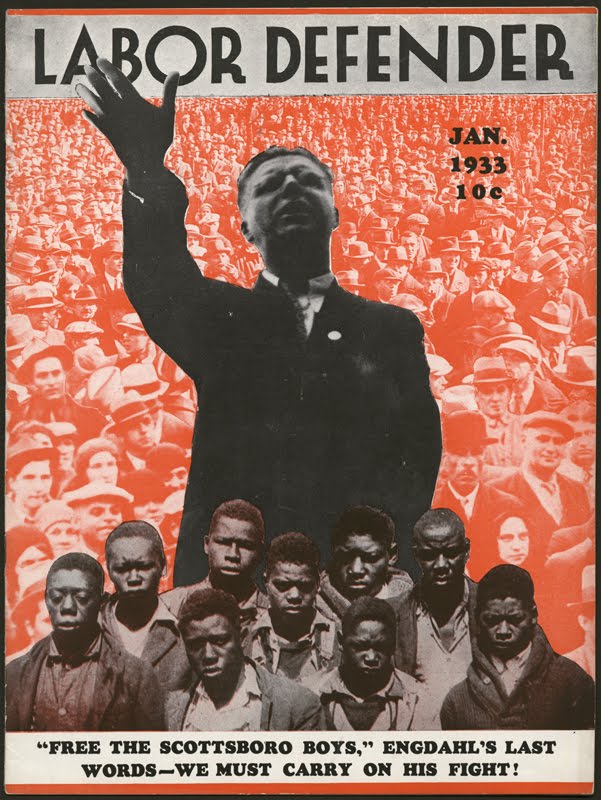
We also talked of the Great Migration of African Americans (like Joe Louis’s family) to Northern cities in the 1920s and 1930s; the crippling effects of the Great Depression made worse by racism; the trials and tribulations of the nine “Scottsboro Boys” who barely escaped lynching only to endure years in prison during a slew of trials, appeals, mistrials, and retrials in a legal campaign organized by the Communist Party of the United States of America; the Roosevelt Administration’s efforts to provide some measure of economic security and parity for unemployed African Americans within the federal relief programs.
Finally, we wrapped up by coming full circle back to Joe Louis and other African Americans who were encouraged to participate in helping Uncle Sam win the Second World War, cognizant that there was still much to be done for civil rights in America, but only after the threat of the Nazis’ New Order was eradicated.


Friday, March 19, 2010

WE WANT JUSTICE!

FORMER SUPREME COURT JUSTICE VISITS THE WOLFSONIAN-FIU LIBRARY

Yesterday afternoon, the library staff had the privilege of welcoming Sandra Day O’Connor, first woman Associate Justice appointed to the Supreme Court, where she served from 1981 until her retirement in 2006. Ms. O’Connor was treated to a sampling of Americana from the library collection, including some First World War sheet music covers and other propaganda, a variety of New Deal materials, and some Second World War propaganda designed for consumption overseas.


Ms. O’Connor was particularly taken with some CCC (Civilian Conservation Corps) ephemera, reminiscing how a couple of camps had been established in or about her father’s ranch out West. She recalled that years later a number of former “city kid” enrollees in Roosevelt’s “Tree Army” who had never before been exposed to rural life, had made return pilgrimages to the campsite which so inspired them with a new-found respect for nature.

Naturally, we also displayed some of the law-related materials in our collection for Ms. O’Connor to peruse. The library holds some extraordinary oversized books illustrated by Violet Oakley, an important Arts & Crafts designer and muralist responsible for painting forty-three murals in the State Capitol, Senate, and Supreme Court buildings in Harrisburg, Pennsylvania. One such portfolio, Law Triumphant, containing: The opening of the book of the law and The miracle of Geneva (1933) includes some beautiful color reproductions of some of the murals she designed for the Supreme Court building.

The library also has a number of rare items documenting the infamous “Scottsboro Boy” trials of the 1930s that so polarized depression-era Americans. When nine African-American youths were unjustly accused of raping a couple of white women, their defense was taken up by the Communist Party of the U.S.A.’s legal arm, the ILD (International Labor Defense). Eventually, defense appeals against biases juries and demands for retrials were heard by the Supreme Court of the United States. The Communist Party also planned to publish a linocut block book to help propagandize the cause and expose racial injustice under the Capitalist system. The library holds a unique prototype manuscript for that project that was never realized at that time.

Finally, we included a book with excerpts from Thomas Paine’s “Rights of Man.” Published by the Heritage Press in 1961, the hardcover edition with “full linen cloth on which blaze the red flames of revolution” was designed by Roderick Stinehour, bound by Frank Fortney “and his fellow sans-cullottes,” with illustrations inside by Socialist activist and engraver, Lynd Ward.


Saturday, December 5, 2009

THEY DID NOT DIE!

TWO SCHOLARS VISIT TO REVIEW OUR RARE SCOTTSBORO BOYS MATERIALS
After a late night Art Basel event in which 192 visitors flooded into the library for a look at some of highlights from our collection of rare books, it was a relief to have only a single appointment with two visiting scholars to contend with this Saturday morning. James Arthur Miller, professor of English and American Studies at the George Washington University, and Susan Dabney Pennybacker, Professor of European History at Trinity College came to the library with an interest in seeing materials related to the infamous Scottsboro trial. Nine African American youths riding the rails in search of work during the Great Depression were pulled from the train in Scottsboro and unjustly accused of raping two white girls also discovered on the train. Narrowly escaping a lynching, the youths were tried and condemned to death by an all-white jury in a sham court trial. Eager to expose Southern racism, Capitalist labor exploitation, and to recruit new party members among African Americans, the legal branch of the Communist Party of the United States of America, (the ILD, or International Labor Defense), took on their case and demanded a retrial. As the resultant court cases and appeals dragged on for several years, the Party organized an international propaganda campaign and demonstrations across the globe in support of the “Scottsboro Boys.” Both of the visiting scholars have written important monographs on the subject published by the Princeton University Press in paperback: Professor Miller’s work is entitled Remembering Scottsboro: The Legacy of an Infamous Trial, and Professor Pennybacker’s history, From Scottsboro to Munich: Race and Political Culture in 1930s Britain.

Among the Scottsboro-related materials in our own collection is one particularly rare and possibly unique item of interest: a mock-up for a linoleum block book designed by Lin Shi Khan for the Communist Party, but which was apparently never published at the time. Our block book has original notes for captions scrawled on the pages opposite the linocut illustrations, with some editorial comments and corrections. (A later version of the block book prototype was later discovered among the personal papers of the Communist journalist and editor of the New Masses, Joseph North with abbreviated lino-cut captions, and some omitted and some added plates, which was reprinted in 2002 by the New York University Press). Our own copy can be seen in its entirety online at the following web address: http://www.wolfsonian.org/collections/c9/index.html

The scholars were also thrilled to see our extensive holdings of the work of Hugo Gellert, and a portfolio of his work recently donated to the collection—but more about that in another blog.